
More than a champion: How Katie Taylor changed women’s boxing forever
September 17th, 2026 / General
“Anybody can make history. Only a great man can write it.”
Those words, attributed to Oscar Wilde, seem particularly fitting for the story of Irish boxer Katie Taylor, whose career came to an end on 5 September at Croke Park in Dublin. In front of 83,000 spectators, the Olympic champion, two-weight world champion and three-time undisputed champion won her farewell bout on home soil, bringing to a close a boxing journey that had lasted almost three decades.
Taylor’s collection of medals and championship belts alone places her among the greatest boxers of her generation, but her significance cannot be measured purely in titles and victories. Her greatest contribution was the role she played in changing the perception and position of women’s boxing. Over the course of her career, it developed from a discipline still fighting for recognition into a sport capable of filling major arenas, headlining global broadcasts and generating enormous commercial interest. Taylor did not accomplish that transformation alone, but for much of the past two decades she was its most recognisable face.
Women, of course, had been boxing long before Taylor was born. Her career belongs to a history stretching back centuries and featuring generations of fighters who challenged the conventions of their time.
From the pioneers to Taylor
One of the earliest celebrated female fighters was Elizabeth Wilkinson, an English bare-knuckle boxer active in the early 18th century. Contemporary advertisements presented her as a champion, while later accounts credited her with an unbeaten run of 45 contests, although complete records from the period do not survive. Later known as Elizabeth Stokes following her marriage, she fought both individually and alongside her boxer husband in contests involving other couples.
More than two centuries later, Barbara Buttrick became another important figure in the development of women’s boxing. The British fighter began by appearing in exhibition contests on the fairground circuit before continuing her career in the United States, where she became a recognised professional and world champion. At a time when female fighters still struggled to be treated as serious athletes, Buttrick helped establish a path that subsequent generations could follow.
Taylor entered a very different world, but many of the same barriers remained. By the time she began boxing as a child in Ireland in the 1990s, women’s participation was still not officially sanctioned in the country.
Taylor was 10 when she started training under the guidance of her father, Pete, who had boxed himself and later became her coach. With no established competitive structure for girls, she trained in an overwhelmingly male environment while her father was among those campaigning for women’s boxing to receive official recognition.
That breakthrough finally arrived in 2001. On 31 October, the 15-year-old Taylor faced Alanna Audley at the National Stadium in Dublin in the first officially sanctioned women’s boxing contest in Ireland. Taylor won 23-12, while another pioneer of Irish boxing, Sadie Duffy, was the referee.
It was a significant moment in its own right, but few of those watching could have imagined how far Taylor – and women’s boxing – would travel over the following quarter of a century.
Two sports, one choice
Boxing was not Taylor’s only sporting talent. During her youth, she successfully combined it with football and represented the Republic of Ireland at several age levels before progressing to the senior national team. She earned 11 senior caps and scored twice between 2006 and 2009, while her overall number of international appearances across the different age groups was around 40.
Eventually, pursuing both sports at the highest level became impossible, and Taylor chose boxing. It proved a defining decision not only for her own career but, in time, for the wider development of the women’s game.
By the beginning of the next decade, Taylor had become the dominant force in amateur women’s boxing. She won five consecutive World Championship titles between 2006 and 2014, as well as six European Championship gold medals during a period in which she established herself as one of Ireland’s leading athletes.
Her rise coincided with another crucial development. Women’s boxing was finally included in the Olympic programme for London 2012, with Taylor arriving at the Games as one of the sport’s biggest stars and the favourite for lightweight gold.
The response in Ireland demonstrated that her appeal had already extended far beyond boxing. Public screens were installed in her home town of Bray, while thousands of Irish supporters followed her progress in London. In the final, Taylor defeated Russia’s Sofya Ochigava, a familiar rival from previous World and European Championships, to claim Olympic gold.
The victory came 20 years after Michael Carruth had become Ireland’s first Olympic boxing champion at Barcelona 1992. For Taylor, however, London represented something more than another title. Women’s boxing had finally reached the Olympic stage, and one of the athletes who had done most to demonstrate its quality had become its first lightweight Olympic champion.
Taking women’s boxing to the biggest stage
After a long and decorated amateur career, Taylor turned professional in 2016, signing with Matchroom Boxing. The landscape was again very different from the one she had entered as a 15-year-old amateur, but women’s professional boxing was still some distance from enjoying the commercial position and mainstream attention it has today.
Taylor’s progress was rapid. She won her first professional world title in 2017 and became undisputed lightweight champion in 2019 after unifying all four major belts. Her success was accompanied by increasingly prominent positions on major cards and growing audiences, helping to demonstrate that elite women’s boxing could attract viewers on sporting merit rather than simply through novelty.
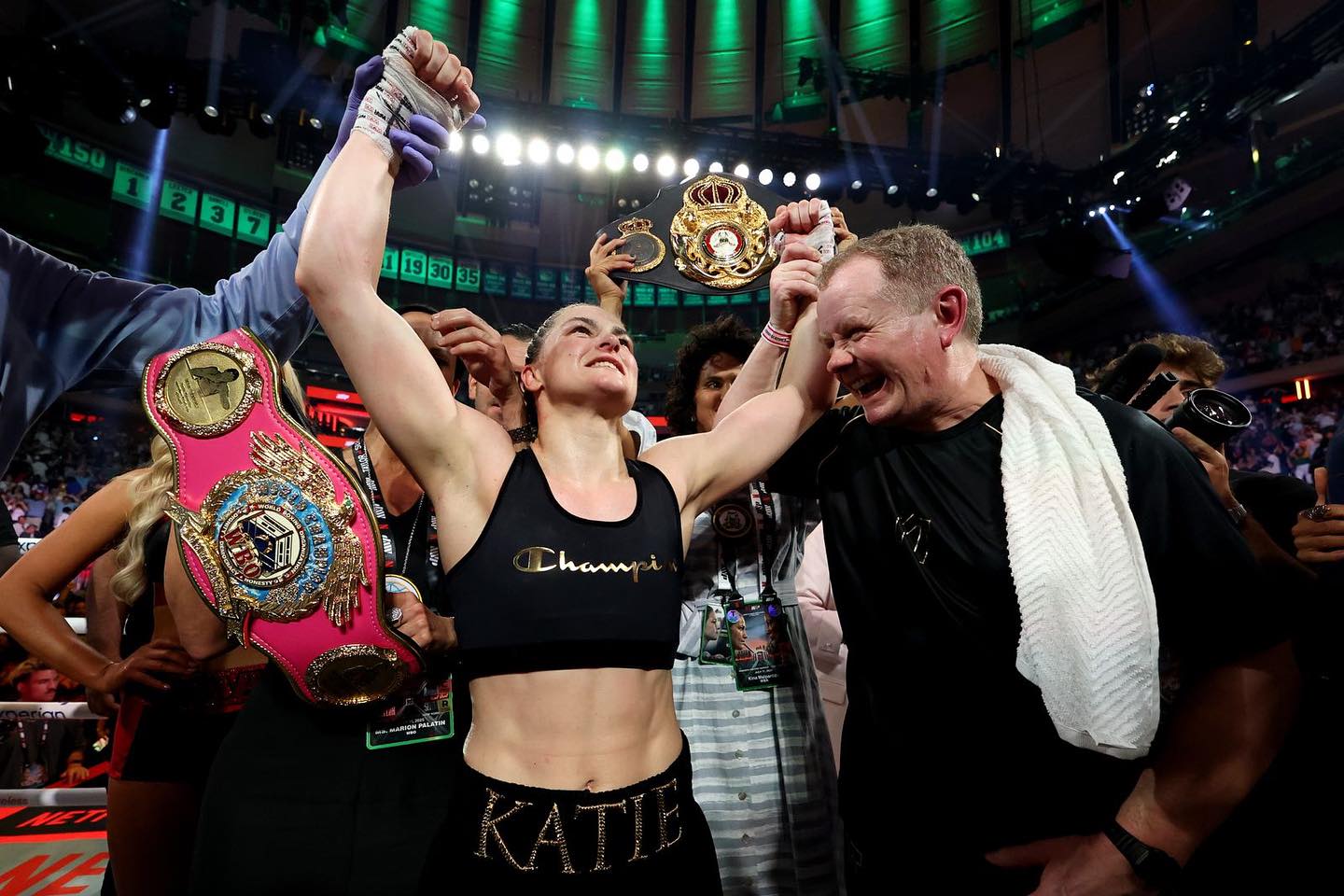
The defining moment came on 30 April 2022, when Taylor faced Puerto Rico’s Amanda Serrano at Madison Square Garden in New York. For the first time in the arena’s history, two female boxers headlined a boxing show there.
The significance of the occasion was considerable, but the quality of the contest ensured that the sporting story matched the historic one. Taylor and Serrano produced 10 fiercely contested rounds in a bout widely regarded as one of the best fights of the year, with Taylor ultimately retaining her titles by split decision.
Their rivalry would eventually stretch to three fights and become one of the defining series of modern professional boxing. By the time Taylor and Serrano met for a third time, the idea of women headlining a major boxing card no longer carried the same sense of novelty. In many respects, that normalisation was itself part of Taylor’s legacy.
The ability to find an answer
Taylor’s achievements were built on an extensive technical arsenal, speed, timing and the amateur schooling developed over hundreds of contests, but one of the qualities that distinguished her throughout her career was adaptability. She could control a fight from range, work at a high tempo, counter in combinations or turn a contest into a physical battle when the opponent and circumstances demanded it.
That ability was tested most severely by Britain’s Chantelle Cameron, who handed Taylor the only defeat of her professional career with a majority-decision victory in Dublin in May 2023. It was a rare experience for a boxer who had spent most of her career finding solutions to whatever stood in front of her.
Six months later, Taylor received the opportunity to answer.
In the rematch, she fought with greater aggression, disrupted Cameron’s rhythm and was prepared to engage in a far more physical contest. Taylor won by majority decision, avenged the only professional defeat of her career and became undisputed champion in a second weight division.
It was a performance that encapsulated much of what had made her so successful. Taylor did not necessarily need every fight to unfold according to one preferred pattern; she had an unusual ability to understand what was required against a particular opponent and adjust accordingly.
From a few hundred spectators to 83,000
For all Taylor had achieved around the world, one ambition remained particularly important to her: fighting at Croke Park.
The Dublin stadium occupies a special place in Irish sporting culture and also has its own chapter in boxing history. Muhammad Ali fought Al Lewis there in 1972, but more than half a century passed before boxing returned to the venue on the scale demanded by a Taylor farewell.
On 5 September 2026, that ambition was finally realised.
The response around Ireland illustrated Taylor’s place in the country’s sporting culture. Tickets were in extraordinary demand, her image appeared on murals and displays around Dublin and her native Bray, and 83,000 spectators eventually filled Croke Park to see her compete for the final time.
Taylor defeated the previously unbeaten Flora Pili of France by unanimous decision over 10 rounds and ended her professional career as an undisputed world champion. After the decision was announced, she left her gloves in the ring, drawing a line under a career that had begun in circumstances almost impossible to reconcile with the scale of her farewell.
The contrast was striking. When Taylor took part in Ireland’s first sanctioned women’s bout in 2001, women’s boxing was only beginning to establish an official place in the country. Almost 25 years later, 83,000 people gathered at one of Ireland’s most famous stadiums to watch a female boxer headline the night.
A legacy beyond titles
Taylor leaves professional boxing with 26 victories from 27 contests, having avenged the only defeat of her career. Before turning professional, she had already become an Olympic champion, a five-time world champion and one of the most successful amateur boxers of her era. In the professional ranks, she became undisputed champion in two weight divisions and built one of the defining rivalries of her generation with Serrano.
Those achievements explain why Taylor belongs among boxing’s great champions, but they do not fully explain her importance.
Her career coincided with, and helped accelerate, a fundamental change in the status of women’s boxing. The young boxer who entered a sport with no officially sanctioned female competition in her home country eventually became an athlete capable of selling out major venues and headlining some of the most important nights in professional boxing.
Her influence also extended beyond female athletes. Taylor’s discipline, longevity, competitiveness and understated personality earned admiration across the sport, while her success provided a model for generations of fighters who came after her.
Every era produces champions, and records that once appeared untouchable are eventually challenged. Influence is more difficult to quantify. Taylor’s can perhaps best be understood by comparing the sport she entered with the one she has now left behind.
In 2001, simply staging an officially sanctioned women’s boxing match in Ireland was a historic achievement. In 2026, 83,000 spectators filled Croke Park to watch Katie Taylor’s final fight.
Few careers can demonstrate their impact on a sport quite so clearly.